Senior infrastructure engineers who migrate Windows Server and VMware workloads to Azure, modernise end-of-life estates, and hand you a secure, governed, cost-optimised landing zone — not a pile of orphaned virtual machines.
Most estates carry a tax: servers nobody dares patch, a domain controller that can't fail, a DR plan that's never been tested, and a cloud bill nobody understands. We take ownership of the whole stack — from Active Directory and Hyper-V to Azure landing zones and FinOps — and leave you with infrastructure that's secure, resilient and quietly affordable. Engineers who have run production estates, not just passed the exam.
Twelve connected capabilities — engaged individually to solve one problem, or end-to-end to run your platform for you.
On-premises Windows Server and VMware workload migration — rehost, replatform and re-architecture using Azure Migrate, with Azure Arc bringing hybrid estates under one control plane.
Active Directory, Group Policy, DNS, DHCP, Failover Clustering, Hyper-V and File & Print — deployed, hardened and modernised by engineers who run them in anger.
Assessment and remediation of end-of-life Windows Server 2012 and 2016 estates, with managed in-place and side-by-side upgrades to Server 2022 and 2025.
Virtual Machines, Virtual Networks, Load Balancers, Availability Zones and VM Scale Sets — with managed disk and storage design sized for performance and cost.
Microsoft Entra ID and hybrid identity with Entra Connect, Conditional Access, and clean Active Directory to cloud integration — single sign-on without the surprises.
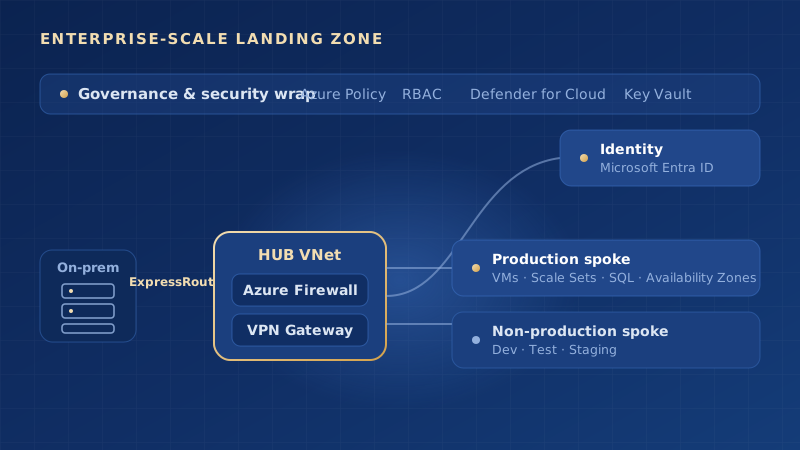
ExpressRoute, VPN Gateway, Azure Firewall and Network Security Groups, designed into a hub-and-spoke topology that segments, secures and scales.
Azure Site Recovery, Azure Backup, high-availability design and disaster-recovery planning — with the recovery actually rehearsed, not just documented.
Microsoft Defender for Cloud, Microsoft Sentinel, Key Vault, Azure Policy and RBAC, wrapped in an enterprise-scale Landing Zone that bakes in compliance from day one.
Infrastructure-as-Code with Bicep, ARM and Terraform, plus Azure DevOps build and release pipelines — environments that are repeatable, reviewed and auditable.
Azure Monitor, Log Analytics, Azure Automation and Update Management — patching and operational health you can prove, with alerting that means something.
SQL Server on Azure Virtual Machines and Azure SQL — deployment, migration and tuning that protects your most critical workload through the move and beyond.
Consumption governance, right-sizing, performance tuning and SQL optimisation — FinOps discipline that turns a runaway cloud bill back into a budget you control.
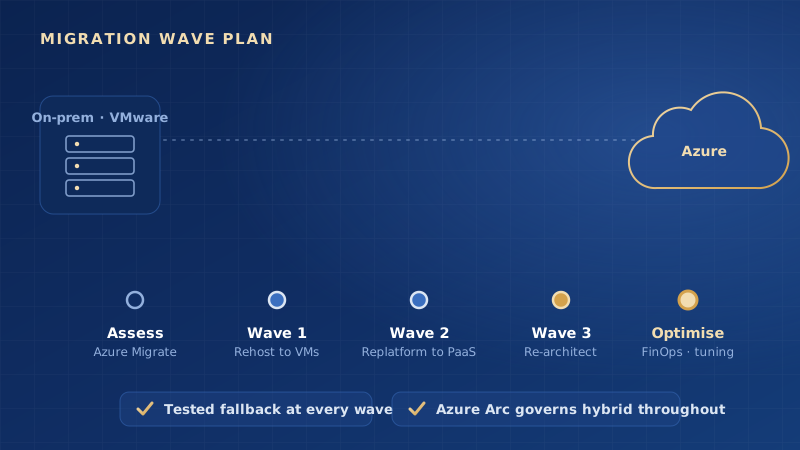
We don't lift-and-dump. Every workload is assessed for the right move — rehost what's fine as-is, replatform what benefits from managed services, re-architect what's holding you back — then migrated in waves with a tested fallback at every step. Azure Arc keeps anything that has to stay on-prem under the same governance.
Plan your migrationYou always know the state of the estate and who owns what — from the first assessment to the operational handover or managed-service run.
Discovery of every server, dependency and identity, with an honest view of risk, end-of-life exposure and current spend — using Azure Migrate and Arc as the baseline.
An enterprise-scale Azure Landing Zone — networking, identity, security, governance and naming — agreed before a single workload moves.
Workloads moved in waves with tested fallback, end-of-life servers upgraded, and everything deployed as reviewable Infrastructure-as-Code.
Monitoring, patching, backup and DR running steadily — plus ongoing right-sizing and FinOps governance to keep the bill where it should be.
An unsupported server estate is a security and audit problem that compounds every month — no patches, rising premiums for extended support, and a growing list of things your cyber-insurer wants to know about.
A typical end-of-life migration, the way we run it. The shape below mirrors how we sequence this work; we'll share named references and figures relevant to your sector on request.
Illustrative engagement shape. Named client references and sector-specific metrics available under NDA on request.
Both. We migrate VMware and Hyper-V workloads to Azure using Azure Migrate, and we're equally happy modernising a Hyper-V estate in place. The assessment tells us the right target for each workload before anything moves.
No. Plenty of estates stay hybrid for good reasons — latency, data residency, hardware not yet depreciated. Azure Arc lets us govern on-prem and cloud servers under one set of policies, so hybrid doesn't mean ungoverned.
Yes — and you don't need a migration to engage us for it. We run right-sizing, reserved-capacity and consumption-governance reviews on existing Azure estates, typically finding meaningful savings in the first few weeks and putting guardrails in place to keep them.
Either. We can hand over a clean, documented, IaC-defined estate to your team, or run it as a managed service — monitoring, patching, backup, DR and optimisation — with one accountable team. Most clients start with a project and keep us on for the run.
Directly. The infrastructure, identity and SQL platform underneath your ERP is exactly what we run — so the same accountable team can own the landing zone your enterprise applications sit on, end to end.
An infrastructure assessment, an end-of-life review, or a managed Azure estate — a senior engineer replies within one business day.